Contribution Guide
This guide is intended to provide guidance to people on their journey with the Querido Diário (Dear Diary) project. It outlines the initial steps that should be taken when interacting with all of the project’s repositories.
Each repository has specific characteristics, described in their own documentation. Once you have finished reading these general guidelines, please read also the README.md and CONTRIBUTING.md files of the repository you are interested in contributing, since they have more specific information about the development environment, installation, execution, goals, the dynamics of interaction in Pull Requests (PR), etc.
Code of Conduct
To ensure our community is welcoming to all people, please read and follow our Code of Conduct in all of our community spaces. By participating in this project, you agree to be bound by the terms specified therein.
Contributing
Ecosystem
Querido Diário has several repositories, allowing one to contribute to whatever they feel more affinity with:
Data Processing - https://github.com/okfn-brasil/querido-diario-data-processing
Backend - https://github.com/okfn-brasil/querido-diario-backend
Frontend - https://github.com/okfn-brasil/querido-diario-frontend
Documentation - https://github.com/okfn-brasil/querido-diario-comunidade
Finding out what to contribute
Knowing git and how the GitHub platform works is a crucial step. We recommend this Digital Ocean tutorial if you are not familiar with them yet.
Issues
In the Issues tab of the chosen repository, you will find tasks or issues specific to that repository. Check if any of them interest you.
When a task is suitable for beginners, it will have the label
good first issue(good first task), and if it is an important task aligned with the project goals, it will have thepriority(priority) label.If you find a task that interests you, comment that you will take on the task. This way, others will know that you are already working on it, and can either offer help or focus on other tasks that have not yet been started.
If a task has a comment expressing someone’s interest in working on it but does not have an associated pull request, and the comment is more than one month old, consider the issue available.
Whether you have chosen an issue to work on or not, you can also comment with relevant information or questions related to the task.
Milestones
If there are no open issues or none interest you, check the Milestones (goals) of the repository. Exploring the files to identify improvement areas that could help the repository reach a milestone is one of the best ways to contribute.
When you find something, open an issue describing the potential improvement and how it relates to one of the milestones. If you plan to take on the task, mention that in your message.
Boards
Displayed in the Projects tab, Boards are resources that group issues of the same theme from one or more repositories in a centralized location, making it easier to navigate through available tasks. See what our Boards are.
Roadmap
The roadmap is a special board that records the strategic direction Querido Diário has on the horizon, the currently prioritized goals, and their progress.
If you would like to suggest new goals for the roadmap, create an issue in the community repository using the “Roadmap Item” template.
Online community
Join the OKBR Discord. There you can quickly ask questions, interact with the maintainers, ask how you can help, and even chat with other contributors.
We also organize and promote activities on Discord such as sprints, regular meetings, pairings, on-call sessions, etc. All of these activities are open and can be followed through this public calendar.
Interacting with reviewers
Be patient, and give reviewers some time. In addition to contribution reviews being complex and demanding time and attention by themselves, a reviewer can be - just like you - another contributor, who’s volunteering their personal time when possible, or has other priorities before being able to review your contribution.
Whether in the form of code or messages with questions and suggestions, try to be objective, but giving details when necessary, to facilitate interactions.
During the reviewing process, a reviewer can open threads requesting improvements to your contribution. In general, it is the reviewers’ role to decide when a thread has ended and mark it as “resolved” in the GitHub interface. That means that both of you agree with the implemented modifications and the contribution can move on.
Important
Querido Diário has several repositories and a limited number of maintainers for each one. Therefore, it may take some time to review a contribution, especially if it is not related to a project goal (mapped in the roadmap).
If you have any questions about this and would like to better understand how to contribute with review and/or priority tasks, please contact us via Discord.
Maintaining
Responsibilities of a Querido Diário maintainer
Respect our Code of Conduct and ensure that folks have a safe and welcoming environment, and that any victim of a breach of these terms has a support channel;
Always justify a suggestion according to: the practices already adopted on the project, legibility and simplicity. It is essential that a civic project has as simple a structure as possible for newcomers;
The project must be tested before a Pull Request is merged;
Keep the commit history organized, preferably following the format below, where every repository change is based on the updated main and merged with a merge commit:
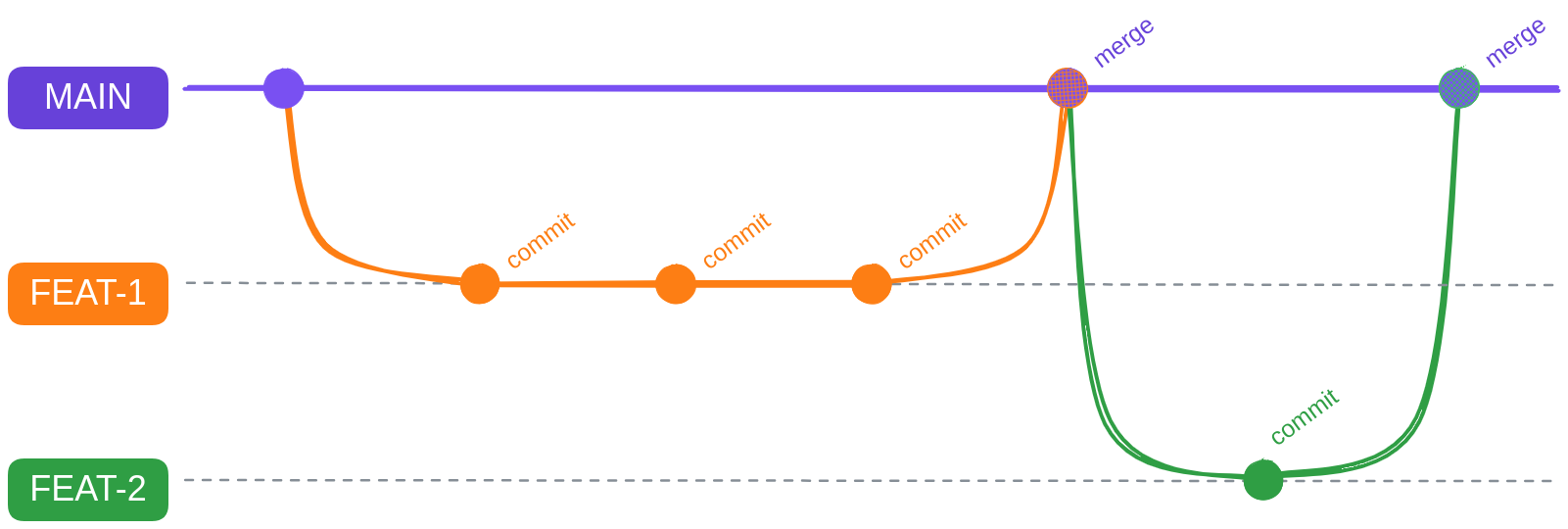
If a Pull Request has too many commits and its messages are not clear, it is possible to squash those commits before merging the Pull Request.